
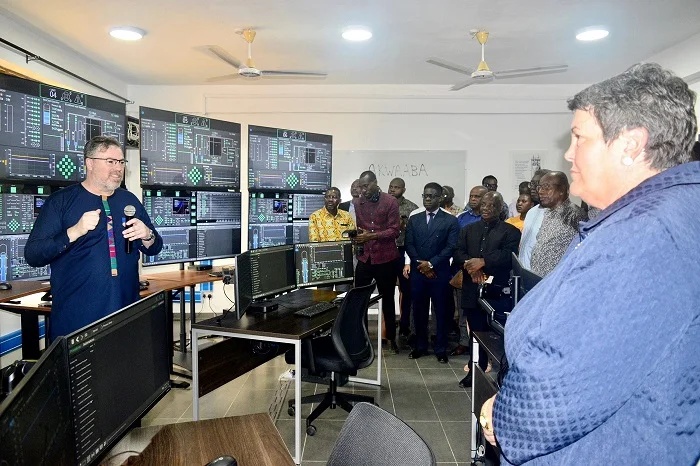
A state-of-the-art simulator has been launched at the University of Nuclear and Allied Sciences to boost Ghana’s energy production.
It is called the NuScale Energy Exploration (E2), the first of its kind in Africa, and aimed to serve as a training and research centre for nuclear scientists.
It was funded by the United States government under the Department of State’s Foundational Infrastructure for Responsible Use of Small Modular Reactor Technology (FIRST) programme.
In addition to the simulator, the partnership between the U.S. and Ghana includes the establishment of a nuclear welding certification programme and a university-to-university partnership with Texas A&M University to develop SMR-related curricula.
The SMR training hub in Accra will serve as a vital resource for workforce development and capacity building across the continent, to foster a new generation of skilled professionals in order to drive the energy sector forward.
In her remarks, the U.S. Ambassador to Ghana, Mrs Virginia E. Palmer, said the U.S nuclear cooperation with Ghana reflects a shared commitment to global non-proliferation and high safety standards.
She said the U.S. was proud to support Ghana in its pursuit of energy independence and economic growth.
Again, Mrs Palmer noted that the United States is a leader in developing new and advanced nuclear technologies to address challenges faced by many regions, including Africa.
“We are particularly pleased to partner with Ghana, a regional leader in civil nuclear development. U.S. small modular reactors (SMRs) and other advanced reactor technologies build on over 65 years of U.S. innovation and expertise in nuclear energy,” Mrs Palmer indicated.
The U.S. Ambassador further outlined that the U.S. government offered its expertise in advanced nuclear technology, safety, and non-proliferation and that it is dedicated to helping Ghana and the Africa continent to realise the full potential of nuclear energy
“Through initiatives like FIRST and other collaborations, we are dedicated to helping Ghana and the African continent realise the full potential of nuclear energy,” she said.
Mrs Palmer stated that the reactors were scalable to meet specific needs and have diverse applications, from power generation and desalination to industrial processes.
Prof. Samuel Boakye-Dampare, the Director General of the Ghana Atomic Energy Commission, highlighted that the launch of the facility was a critical step toward building a skilled workforce capable of meeting the demands of Ghana’s ambitious nuclear energy programme.
“The knowledge and skills developed here will be applied to real-world nuclear reactor operations, ensuring Ghana’s ability to advance in this critical field.”
Additionally, Prof. Boakye-Dampare said the Nuclear Welding Certification Programme, developed in partnership with the International Science and Technology Centre (ISTC), would ensure the availability of a highly skilled workforce capable of supporting the supply chain for nuclear reactors.
Prof. Boakye-Dampare also mentioned that the centre was critical to fostering innovation, research, and local industrial participation, further enhancing Ghana’s nuclear capabilities while promoting economic growth.
Moreover, he said the SMR would provide training opportunities for individuals across the African continent, enhance pedagogy in nuclear physics and engineering, and inspire students to pursue careers in nuclear-related fields.
Prof. Boakye-Dampare stated that the establishment of the Graduate School of Nuclear and Allied Sciences (SNAS) in 2006, in collaboration with the University of Ghana and the IAEA, had been instrumental in building the human resource capacity necessary to support Ghana’s nuclear ambitions.
BY MALIK SULLEMANA
Source – https://ghanaiantimes.com.gh